
When I first started dabbling with digital products on Etsy, I was convinced that the more keywords I could sprinkle into a listing, the better. I’d seen advice that sounded like it encouraged Etsy SEO keyword stuffing, and it felt like the logical thing to do to get noticed in a crowded marketplace. Every title, every tag, every description felt like a battleground for keywords.
It took me a while, and a lot of trial and error, to realize that this approach was actually holding me back. My products weren’t getting the visibility I hoped for, and frankly, my listings probably sounded a bit…robotic.
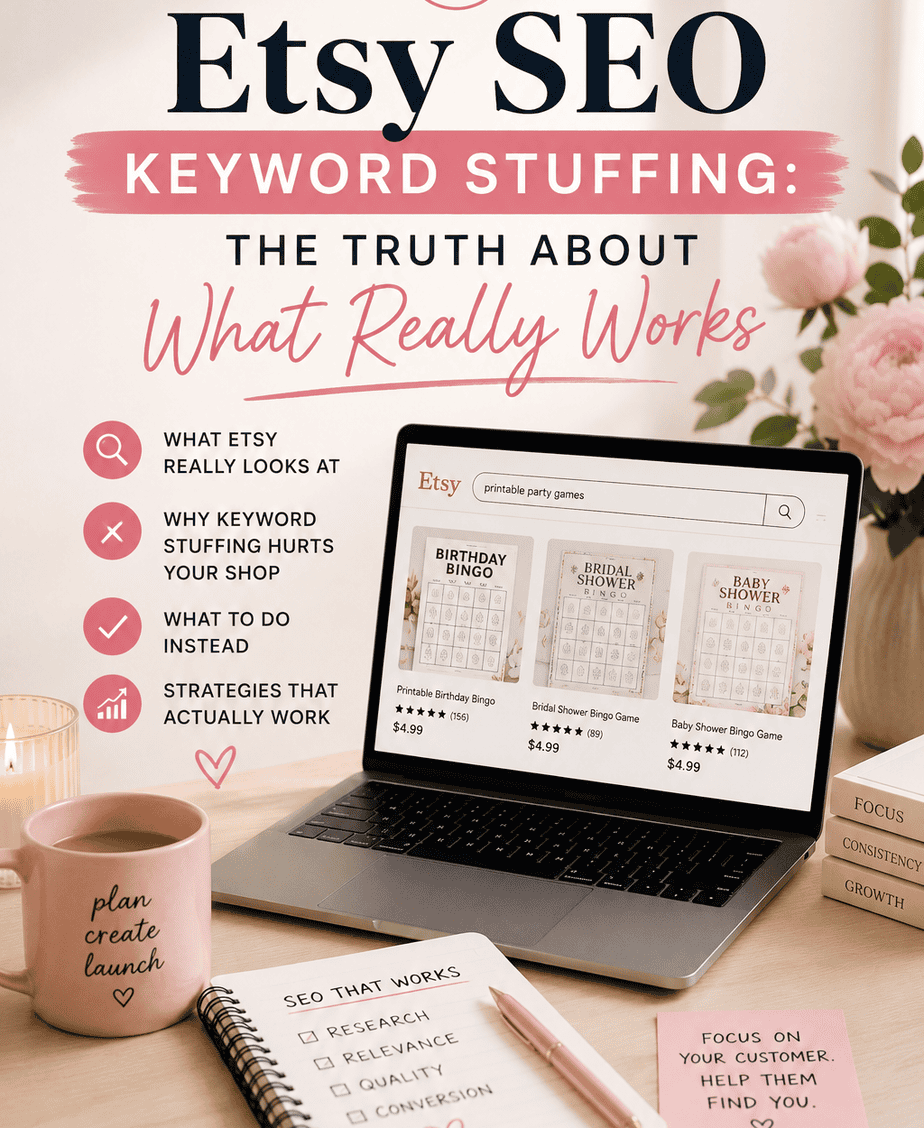
Many new sellers try to cram keywords into their Etsy listings, hoping it helps with SEO. I’ve been there, thinking more is always better. This post debunks that myth and explains what actually works for visibility.
Compare at a Glance
This comparison chart helps you understand the different approaches each resource offers for mastering Etsy SEO.
Swipe to compare →
| Product | Focus | Approach | Keyword Philosophy | Price range |
|---|---|---|---|---|
| Etsy Listing Optimization Guide | Etsy search algorithm | Solid strategy | Connect with buyers | $ |
| The Ultimate Guide to Keywords | Keyword research | Demystifies | Customer search intent | $$ |
| Keyword Research for Etsy Sellers | Keyword choice ‘why’ | Deeper understanding | How buyers search | $$$ |
What I Thought I Knew About Etsy SEO Keyword Stuffing
It’s easy to fall into the trap of thinking that more keywords equals more sales. I remember spending hours researching every possible variation of a keyword, convinced that if I just included enough of them, Etsy’s algorithm would surely favor me. I’d create titles that were a string of descriptive words separated by commas, and descriptions that repeated those words over and over.
My reasoning was simple: if someone searches for “digital planner 2024,” and my listing has that exact phrase, plus “undated planner,” “printable journal,” and “PDF organizer” all mashed together, then I’ve covered all my bases, right? This is the core of what often leads to Etsy SEO keyword stuffing.
Etsy’s Algorithm Prefers Natural Language, Not Jumbles
What I eventually discovered, through a lot of observation and some helpful tips from other sellers, is that Etsy’s search algorithm has gotten a lot smarter. It’s designed to understand natural language. Think about how you search for something online, you use phrases, not just single words. Etsy wants to show shoppers listings that actually make sense and accurately describe the product, not just a list of keywords.
When you stuff keywords, you’re not just making your listing sound unnatural; you might actually be signaling to Etsy that your listing isn’t very relevant or high-quality. The algorithm aims to connect buyers with what they truly want, and a jumbled title doesn’t do that effectively.
Understanding Keywords as Intent, Not Just Words
Instead of focusing on how many times I could repeat a keyword, I shifted my focus to understanding the *intent* behind search queries. What is someone really looking for when they type “printable wall art watercolor”? They’re probably looking for something specific, and my listing needs to reflect that specific intent.
This means using keywords that are:
- Relevant: Do they genuinely describe my product?
- Specific: Are they niche enough to attract the right buyer, but broad enough for discovery?
- Used naturally: Can I weave them into a readable title and description?
It’s about quality over quantity. A few well-chosen, naturally placed keywords will always outperform a laundry list of forced ones. This approach also makes it easier for you to create products, because you’re thinking about who they’re for. If you’re feeling overwhelmed by product creation, focusing on clear intent can even help you figure out how to create a simple digital product in a weekend, because you know exactly what problem you’re solving.
The Real Power of Titles and Tags (Beyond Keyword Stuffing)
Your listing title is perhaps the most critical spot for your primary keywords. It’s the first thing buyers see, and it significantly impacts Etsy’s search ranking. Instead of a long string of keywords, I started crafting titles that read like clear, appealing product names, with my most important keywords at the beginning.
For tags, Etsy gives you 13 slots, and using all of them is definitely a good idea. But again, it’s not about repeating the same words in different orders. It’s about using those slots for different but related keywords and long-tail phrases. For example, if I sell digital planner stickers, my tags might include:
- digital planner stickers
- goodnotes stickers
- ipad planner stickers
- aesthetic stickers digital
- png planner stickers
- journaling stickers
- planner essentials
- digital scrapbooking
- productivity stickers
- cute planner decor
- undated planner accessories
- sticky notes digital
- boho planner stickers
Notice how they are all distinct, yet related. They cover different ways someone might search for the product. This gives Etsy more signals without resorting to Etsy SEO keyword stuffing.
Descriptions: Sell, Don’t Just Keyword Pile
The product description is where you truly sell your item and connect with your buyer. While it’s important to include keywords naturally here, its primary purpose is to describe your product in detail, highlight its benefits, and answer potential questions. If you’re using AI for product descriptions, tools like Lovable can help you generate engaging copy that incorporates keywords naturally, rather than just dumping them in.
I learned to write descriptions that told a story about the product and its use, rather than just listing features. For instance, if I’m selling a watercolor digital art print, I’d talk about the feeling it evokes, the kind of room it would suit, and how easy it is to print, instead of just repeating “watercolor art print” five times.
It’s about showing empathy for the buyer. What do they need to know? What will excite them about your product? This thoughtful approach not only helps with conversions but also signals to Etsy that your listing is helpful and informative.
On My Desk
A few tools and reads I keep coming back to — grab what fits your season.

Etsy Listing Optimization Guide
This guide helped me understand the nuances of Etsy’s search algorithm and how to genuinely connect with buyers. It’s less about tricks and more about solid strategy.

The Ultimate Guide to Keywords
A practical book that demystifies keyword research for small businesses, showing you how to find what your customers are truly searching for.

Keyword Research for Etsy Sellers
This book goes a bit deeper into the ‘why’ behind choosing certain keywords, which I found really helpful for understanding how buyers actually search.
Steering clear of Etsy SEO keyword stuffing felt counter-intuitive at first, like I was missing out on opportunities. But in reality, it freed me to create listings that were genuinely helpful and appealing to my customers.
It allowed me to focus on creating quality products and presenting them in a way that truly resonated, rather than just trying to game an algorithm. It’s a much more sustainable and enjoyable way to build a presence on Etsy.
Frequently Asked Questions
Yes, keyword stuffing can actually harm your Etsy SEO. Etsy’s algorithm prioritizes listings that are clear, natural-sounding, and genuinely helpful to shoppers, which keyword-stuffed listings often are not.
Your Etsy title should focus on your most important and relevant keywords at the beginning, forming a clear and descriptive product name. Aim for a title that is readable and appealing to both buyers and the search algorithm.
Use all 13 tag slots for unique and relevant keywords or long-tail phrases. Avoid repeating the same words in different tag combinations; instead, focus on covering various search intents related to your product.
Yes, your Etsy description helps SEO by providing more context to Etsy’s algorithm about your product. It’s also crucial for converting shoppers into buyers, so focus on rich, descriptive content that naturally includes keywords.
Get Her Digital Era in your inbox
Weekly notes on building your digital era — quiet strategy, real lessons, no fluff.
Subscribe free →