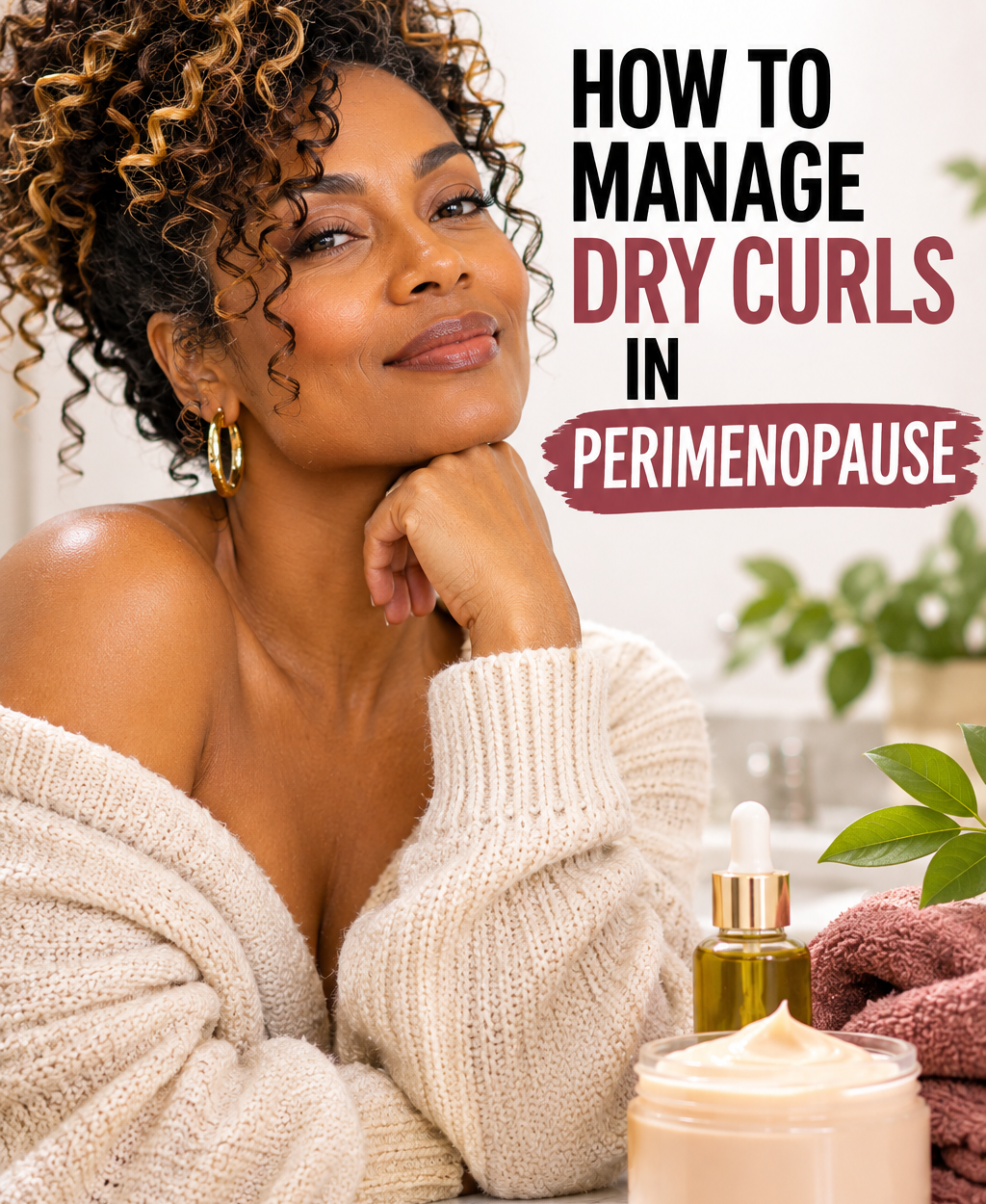

Hormone shifts alter the scalp environment long before most women expect perimenopause symptoms to show up. A routine that worked beautifully for five years can suddenly leave your hair feeling like dry straw, with curls that refuse to clump and ends that tangle the moment they dry. Managing dry curls in perimenopause requires shifting away from heavy styling butters that just sit on the hair surface, focusing instead on supporting lower sebum production and protecting fragile strands.
When estrogen levels fluctuate and gradually decline, your scalp produces fewer natural oils, while individual hair strands often grow in finer and more porous. This guide breaks down the biological shifts behind these texture changes, practical routine tweaks that keep hydration in your hair, and three targeted formulas that help restore bounce and softness.
If your go-to products suddenly leave your hair rough and thirsty, shifting hormones may be the reason. Here is how to restore moisture to your curls without adding hours to your routine.
Compare at a Glance
Compare these perimenopause curl treatments by format, primary target, time commitment, and price tier to simplify your routine.
Swipe to compare →
| Product | Product type | Best for | Application time | Price range |
|---|---|---|---|---|
| Briogeo Don’t Despair, Repair! Deep Conditioning Mask | Rinse-out mask | Brittle, hormonal curls | 10 shower minutes | $$ |
| Kérastase Nutritive 8H Magic Night Serum | Overnight leave-in serum | Parched ends | Overnight | $$$ |
| Curlsmith Weightless Air Dry Cream | Leave-in cream | Fine, thinning curls | Post-shower styling | $$ |
Quick answer: As natural oil production slows down during perimenopause, textured hair loses lubrication and moisture quickly. Swap harsh clarifying cleansers for gentle, conditioning washes, layer lightweight emollients on soaking wet hair, and use friction-free sleep protection to preserve natural moisture.
My pick: Briogeo Don’t Despair, Repair! Deep Conditioning Mask offers the most reliable blend of fatty alcohols and softening emollients for parched, changing curl patterns.
- Reduced sebum from hormonal shifts causes curls to dry out faster than before.
- Layering heavy raw butters often backfires by causing buildup rather than actual softness.
- Using water-based humectants sealed with light conditioning emollients keeps curls supple between wash days.
Why Dry Curls in Perimenopause Happen
Estrogen plays a major role in keeping skin and hair supple by stimulating the sebaceous glands to produce natural oils. During perimenopause, which often begins in your late thirties or forties, estrogen levels do not decline in a straight line. Instead, they spike and plunge unpredictably. As estrogen dips relative to androgens, sebum production drops significantly. For textured hair, which already struggles to move scalp oils down spiral shapes, this drop leaves lengths and ends starved for lubrication.
At the same time, individual hair follicles can change in shape and caliber. You might notice single strands that feel coarser, curlier, or more wiry than your original curl pattern, while overall strand density becomes finer. These wiry strands have an uneven cuticle layer that lets internal water evaporate quickly. I learned this the hard way when I tried slathering on heavy butter to soften rough patches, only to end up with limp, greasy roots while my ends stayed dry underneath.
Because the cuticle layer does not lie as flat as it used to, curls also catch on one another, creating friction, split ends, and sudden tangles. Recognizing that this dryness stems from biology rather than user error helps you choose methods that genuinely work with your new texture instead of fighting it.
Practical Daily Steps to Manage Dry Curls in Perimenopause
Restoring softness does not require a complex ten-step routine. A few targeted adjustments can make a significant difference in how your curls hold moisture throughout the week.
1. Rethink Your Cleanser
Traditional sulfate shampoos strip away the small amount of sebum your scalp is currently making. Switch to a gentle, low-foaming cleanser or an alternating co-wash routine. If your shelf is crowded with clarifying bottles you rarely need, it helps to edit down your stash to simplify your regimen; reviewing curly hair products you don’t need and what I do instead can free up space and prevent accidental over-stripping.
2. Apply Hydrators to Soaking Wet Strands
Because aging curls lose water quickly, apply your leave-in formulas while your hair is still thoroughly wet from the shower. Water provides the hydration, while your product acts as the blanket that slows evaporation. If you need a reliable base layer before styling, pairing your routine with one of the best curl creams for dry, thirsty hair helps cushion the cuticle and maintain slip through the week.
3. Minimize Overnight Friction
With less natural sebum coating the strands, mechanical friction from cotton bedding can lead to breakage and severe morning frizz. Sleeping on smooth fabrics helps protect the delicate cuticle layer. If you are deciding between different night protection methods, reviewing the differences between silk pillowcases and satin bonnets will help you select the lowest-effort option for your sleep style.
Three Targeted Hydrators for Aging Curls
When selecting formulas for perimenopausal dryness, look for products built around slip, fatty alcohols, and lightweight plant oils that help soften hair without leaving a greasy residue.
Briogeo Don’t Despair, Repair! Deep Conditioning Mask
This intensive treatment is formulated with rosehip oil, B-vitamins, and algae extract to soften brittle hair. It performs particularly well on curls that feel rough to the touch or snap easily during detangling, restoring elasticity without turning hair mushy. The rich, creamy consistency coats strands thoroughly to make finger-detangling painless on wash day. The main drawback is that it requires ten minutes of dwell time in the shower, which may test your patience if you prefer a fast routine.
Kérastase Nutritive 8H Magic Night Serum
Designed as an overnight leave-in treatment, this serum uses plant-based proteins and niacinamide to nourish parched hair while you sleep. It is an ideal fit for women who wake up to rough, parched lengths on day two and day three but do not want to re-wet their entire head. It absorbs completely into the hair fiber without leaving behind residue on your pillow. The notable downside is the higher luxury price point, along with a noticeable floral fragrance that may not suit sensitive noses.
Curlsmith Weightless Air Dry Cream
This leave-in conditioner focuses on providing lightweight hydration using hyaluronic acid, castor oil, and babassu. It solves the common perimenopausal problem of curls feeling dry while simultaneously thinning out and losing volume. Because the formula avoids heavy waxes and heavy butters, it softens parched ends without flattening your curl shape. However, if your curls are naturally very thick, coarse, and dense, this lighter lotion may not supply enough weight to tame stubborn flyaways.
Which One Should You Choose?
Choosing the right product comes down to your current curl density and how your hair behaves between washes:
- If your hair feels straw-like, tangles easily, and needs a deep weekly moisture boost, choose Briogeo Don’t Despair, Repair! Deep Conditioning Mask.
- If your curls lose softness overnight and you want effortless hydration between wash days, choose Kérastase Nutritive 8H Magic Night Serum.
- If your hair texture has turned finer and weighs down easily under heavy styling products, choose Curlsmith Weightless Air Dry Cream.
The Picks
Here are the products worth reaching for — each one earns its spot for a reason.

Briogeo Don’t Despair, Repair! Deep Conditioning Mask
Formulated with rosehip oil and B-vitamins to restore softness and elasticity to brittle, hormonal curls. It requires about ten minutes of shower time to deliver its best softening effect.

Kérastase Nutritive 8H Magic Night Serum
A lightweight overnight leave-in that replenishes moisture to parched ends without leaving greasy residue on your pillowcase. The luxury price point and noticeable floral fragrance may not work for everyone.

Curlsmith Weightless Air Dry Cream
A leave-in conditioner enriched with hyaluronic acid that hydrates fine, thinning curls without weighing them down. Very coarse or extremely dense hair patterns may find it slightly too lightweight for strong frizz control.
If your hair feels noticeably brittle on wash day, Briogeo Don’t Despair, Repair! Deep Conditioning Mask gives you the deep nourishment you need. If you want mid-week softness without washing your hair again, Kérastase Nutritive 8H Magic Night Serum works overnight to smooth rough patches. If your strands feel fine and collapse under heavy products, Curlsmith Weightless Air Dry Cream delivers soft hydration while keeping your natural volume intact.
Learning how to manage dry curls in perimenopause comes down to gentle consistency rather than layering on heavy products. Give your curls extra water, handle delicate ends with care, and let your routine adapt to the stage of life your hair is in right now.
Frequently Asked Questions
Hormonal shifts cause changes in follicle shape and blood supply to the scalp. As estrogen decreases, some hair follicles shrink or change shape, which can make previously uniform waves or curls become looser, coarser, or uneven across different sections of your head.
While staying hydrated supports general cellular health, drinking extra water cannot directly replace the natural sebum output lost due to hormone shifts. Topical conditioning agents, gentle cleansing, and physical moisture barriers are necessary to keep the hair shaft lubricated.
Stopping shampoo entirely often leads to scalp buildup, which can block follicles and worsen thinning hair. Instead of quitting shampoo, switch to a mild, sulfate-free cleanser and use it once or twice a week to keep your scalp clean without stripping your remaining natural oils.


